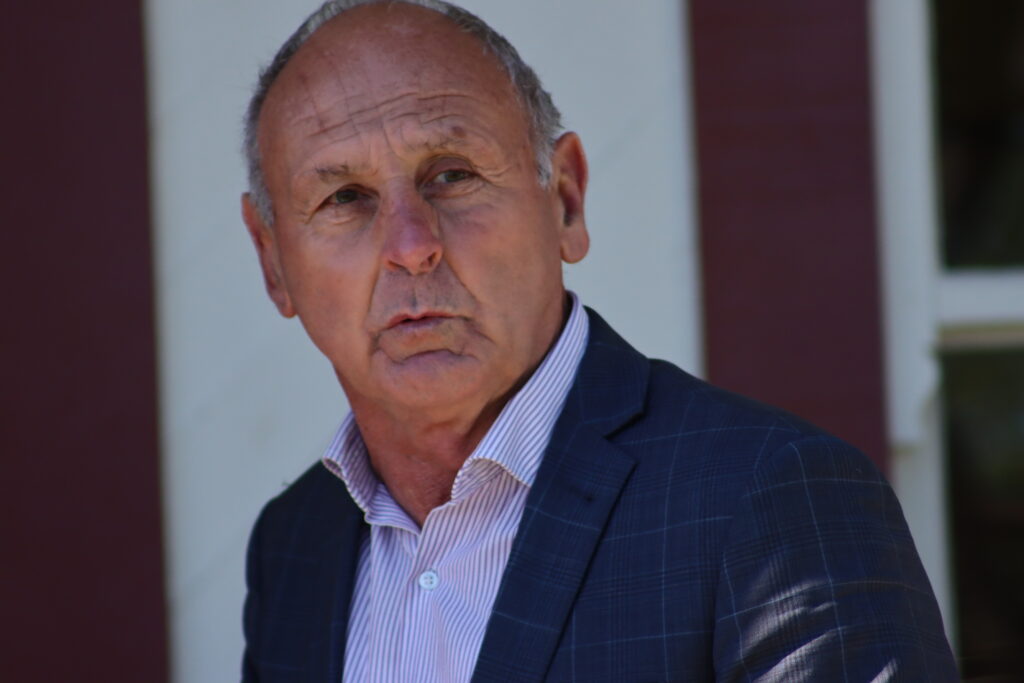
By Moana Ellis, Local Democracy Reporting
Ruapehu Mayor Weston Kirton says a new cornerstone Government policy will strip communities of the ability to decide the level of services they want and risks pushing councils into a spiral of long-term underinvestment seen in Australia.
Kirton says the Government’s 2-4% rates cap – announced ahead of legislation expected next year to control council spending – will remove democratic choice, not just constrain councils.
He also questions whether the cap will deliver discipline or simply defer pain.
“When councils are forced to cut spending to meet a cap, it becomes impossible to lift rates later to catch up on deferred investment,” Kirton told Local Democracy Reporting.
“This leads to a cycle of underfunding and persistent deficits.”
Kirton said the district had already begun modelling ways to pull average rates increases back under 5% next year, in line with his election commitment.
The intention was to present ratepayers with “a menu of options” showing which services could be reduced or removed to achieve lower increases, and which could be retained or restored if the community agreed to pay more.
“The introduction of a hard rates cap removes that choice,” he said. “Ratepayers will no longer be able to ‘pay more to get more’, even if they collectively want to retain a higher level of service which they are happy to pay for.”
While reducing services did not automatically mean poorer-quality delivery, Kirton said the bigger danger lay in what has already played out across Australian councils: spending cuts that later become impossible to reverse.
He said a similar pattern had already emerged in New Zealand. Councils that held off investment in water infrastructure later faced large rate hikes when new Government standards required upgrades.
Although water has been excluded from the cap, Kirton warned that the same risks apply to other essential assets – roads, community facilities, parks, bridges and core infrastructure.
If investment was pushed too low, these assets would deteriorate and eventually require “much larger corrective increases in the future or force service cuts that no one wants”.
The mayor also raised concerns about “wider equity and affordability”.
“While the cap limits funding for “everything except water” to 2-4%, water users themselves will face significantly higher charges.”
Kirton said Department of Internal Affairs (DIA) modelling for the Ruapehu-Whanganui water plan shows Ruapehu water users face a 92% increase in water charges over the next 10 years – “with no affordability protections”.
The DIA last week recognised Ruapehu water affordability issues when it accepted the joint water services plan, saying it expected the new entity to investigate price harmonisation and joining up with additional councils.
“Even though water will sit outside council under Local Water Done Well, we must still be mindful of the combined impact of general rates plus water charges on our ratepayers.
“Households experience these together as one cost-of-living pressure. The cap does not ease that burden.”
On the new requirement for councils to seek regulator approval to exceed the cap, Kirton said it was not yet clear how the approval system would operate.
While he supports efforts to limit rate rises, Kirton said the Government has not addressed the core drivers of affordability and the fundamental flaws in council funding.
“As Ruapehu does not have any major revenue-producing assets or investments, we are significantly more reliant on rates, fees and charges, grants and subsidies, and debt to fund our services, projects, and other activities.”
New revenue mechanisms – such as tourism levies, infrastructure funding or tax-sharing – would be essential, he said.
“The issues with local government funding based around rates reliance will not be solved [by the] Government’s reform proposals.”
Local Government Minister Simon Watts said the rates target model was designed to balance councils’ ability to fund essential infrastructure and sustainable growth, while keeping rates affordable.
“The Government is aware of the risks of underinvestment in infrastructure and asset maintenance,” Watts told Local Democracy Reporting.
“As we regulate the cap, councils will be monitored to ensure they are not underinvesting in asset management and maintenance.
“This is also one of the reasons why we are setting a minimum to the band to clearly signal the need for ongoing and regular investment.”
On council funding, Watts said revenue was only one side of the equation.
“It is important that councils focus their spending and ensure it is on the basics.
“I expect councils to be using the full suite of funding and financing tools that they have available – ensuring fees and charges accurately recover the costs of providing private good services, using debt financing to spread the costs of infrastructure over time and maximising the new funding and financing tools under the Going for Housing Growth programmes, including Development Levies and the Infrastructure Funding and Financing Act.”
Awa FM – Te Reo Irirangi o Whanganui
For more of our people, our stories, our way, click News or follow us on Facebook.