
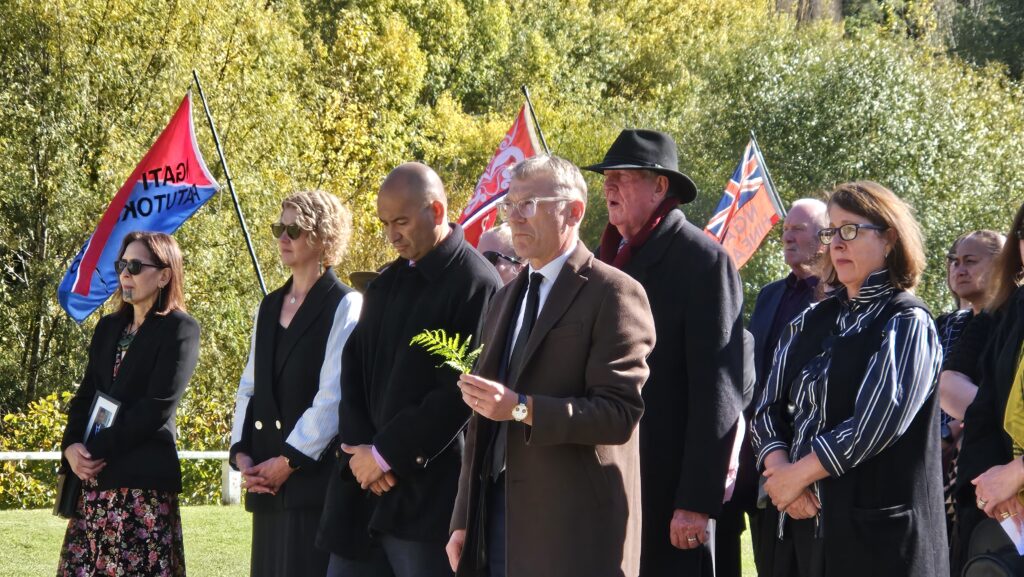
Thank you for your generous welcome today and particularly the beautiful poi and waiata, which I will never forget. I want to acknowledge this special occasion as we gather to mark the signing of He Rau Tukutuku, the Ngā Hapū o te Iwi o Whanganui Deed of Settlement.
I sincerely appreciate the reflections and the challenges that Kahurangi has made this afternoon. The Deed is a testament to your people, who, despite the profound injustices that we’ve heard and the loss that we have heard, have carried through the generations with dignity and trust.
And as Kahurangi said, partnerships are built on trust, respect, understanding. And across those areas, the Crown has frequently fallen short.
Since the signing of Te Tiriti in 1840, Crown actions have caused Ngā Hapū o te Iwi o Whanganui immense harm.
The Crown has consistently failed to engage with Whanganui iwi and hapū in the spirit of partnership envisaged by those who signed Te Tiriti.
And before a new chapter can begin, the Crown must acknowledge and apologise for the actions and omissions.
This is the formal apology:
The Crown is sincerely sorry that it failed to honour its obligations to treat you as a treaty partner. You entered into the 1848 transaction for a block of your treasured whenua seeking to strengthen an enduring relationship with the Crown. The Crown profoundly regrets its failure to negotiate this transaction with you in utmost good faith.
The Crown did not negotiate the price for your land fairly and you lost kāinga on the lands that were not reserved.
The Crown sincerely apologises that it unjustly exiled your tūpuna to Tasmania in 1846 and extended martial law in 1847 without sufficient justification. The Crown profoundly regrets that its actions in the 1860s led to war and bloodshed in Whanganui.
It is particularly sorry to have caused tensions between hapū, many of whom were divisively labelled as hostile, and for the long-lasting stigma that resulted.
In the years following the war, many of your tūpuna joined the community at Parihaka and engaged in peaceful resistance against the Crown. In response, the Crown arrested, imprisoned and forcibly drove away your tūpuna from their homes in Parihaka. And for this, it is deeply remorseful.
The Crown acknowledges the commitment of your iwi and hapū to their whenua and rangatiratanga. However, the Crown promoted land laws that individualised ownership of your whenua and facilitated the alienation of much of your land.
These laws undermined your hapū and iwi structures, and for this the Crown is deeply sorry.
The Crown also took and, in some cases, damaged your land for public works and took thousands of acres for scenery preservation along the Whanganui River.
The Crown is sincerely sorry for its failure to protect your collective control over large areas of land you still retained, and for the bitter losses of other land which left you feeling marginalised in your own whenua.
The Crown deeply regrets that your people have suffered from socio-economic deprivation, which has led many to leave their kāinga, and to become disconnected from their tūrangawaewae, and for its failure to protect te reo Māori within the Whanganui rohe.
Ngā Hapū o te Iwi o Whanganui, you have always sought to protect your people and secure peace and prosperity for them. You have acted with great mana in your relationship with the Crown.
However, the Crown has at times disrespected your friendship. With great remorse and in recognition of its many failings, the Crown sincerely apologises for its grievous breaches of Te Tiriti, the Treaty, against you and pays tribute to your resilience.
With the settlement and this apology, the Crown hopes to atone for the harm it has inflicted on you and to restore its tarnished honour.
In 1869, your rangatira held out the symbol of He Whiri Taunoka, knotted taunoka, broom stems, to the Crown. A token of hope for the end of the conflict between us and better times in the future.
The Crown humbly seeks, at long last, to respond with reconciliation and truly live up to the aspirations of Te Tiriti o Waitangi, the Treaty of Waitangi.
The Crown looks forward to rebuilding its relationship with you, your tamariki and your mokopuna, and to better times.
[End of formal apology]
As Kahurangi said, this apology needs to mark a new beginning, recognising cultural, historic and spiritual associations of uri to the rohe.
The deed provides for the transfer of 27 sites of significance to Takapau Whāriki Trust, including Pākaitore.
A culture revitalisation fund of $15.5 million as a foundation for marae and te reo revitalisation, statutory acknowledgements over reserves and conservation areas, which reflect deep connections between people and place, and a $30 million package of financial and commercial redress, creating opportunities for future generations and to assist iwi to cultivate economic and social opportunities.
The redress includes the right to purchase 62 properties, including forestry land and the Te Puna Hapori site, the Whanganui Intermediate School, as well as the first right of refusal over specific Crown-owned properties.
The settlement package also offers resources and partnerships to enhance the mana and well-being of iwi and hapū of Whanganui. Together, the components support the revitalisation of Ngā Hapū o te Iwi o Whanganui, enabling opportunities for future generations.
I want to acknowledge members of the negotiation team. Trustees, Ken in particular, you carried an enormous responsibility of negotiating this over nine years of negotiations and many, many decades beforehand with dignity, integrity and perseverance.
And I do want to acknowledge my predecessor, the Honourable Andrew Little, and my good friend and colleague, the Minister of Conservation Tama Potaka. I want to acknowledge the leadership of the Crown negotiator, the Honorable Rick Barker, and the many people at Te Tari Whakatau and staff over many agencies, including the Department of Conservation, who added to this and developed this package.
I do particularly want to acknowledge Ngā Hapū o te Iwi o Whanganui and your team who have had the courage to carry this forward, and of course I acknowledge, at a time like this, the emotions that come with that.
The recognition that making a step such as this is never easy. Not everybody always agrees and harsh words are often said. And so I thank you.
I also acknowledge at a time like this, minds turn to those who are no longer here, who have been part of that journey. And as I walked through Te Kiritahi and saw all the faces and going back over many generations, I want to acknowledge them. In particular, Hera Peina, recently passed, and Morvin Simon. Acknowledging those who have passed away and are not with us today, e ngā rangatira, moe mai rā, okioki.
I am conscious that it’s easy to make these apologies, easy to say these words. But of course, they mean nothing if they’re not followed up. The Crown, of course, represents today the people of New Zealand. They’re all people. They’re not perfect. And the collective will is not perfect.
But we can strive to do better than we have, and to build a lasting relationship, rātou ki a rātou, tātou ki a tātou.
This Deed of Settlement signing is not the end, it’s the beginning. It’s the stepping into a new phase of collective responsibility for the future. Mā te kotahitanga e whai kaha ai tātou. Mā te aroha e ora ai te iwi. Mā te mana motuhake e ara takina ai te huarahi mō ngā uri whakatipu.
E ngā hapū o Whanganui, ngā mihi nunui ki a koutou.