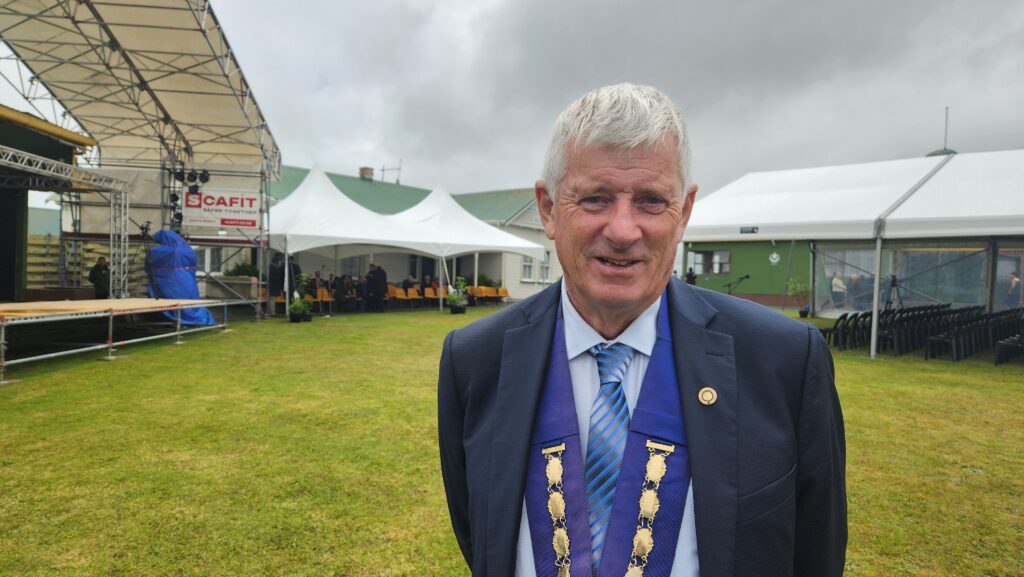
By Moana Ellis, Local Democracy Reporting
Rangitīkei Mayor Andy Watson says local government is entering a period of unprecedented upheaval.
He warns councils are losing decision-making power, with major decisions shifting to regional planning bodies and water entities, and rapid, centrally driven reform placing long-standing local relationships under pressure.
Speaking at Rātana Pā during four days marking the birth of Rātana founder Tahu Pōtiki Wiremu Rātana, Watson said the next two to three years would be especially challenging for councils and their communities.
“It’s going to be a really tough gig.”
He pointed to the pace and scale of reform across local government, including changes to water services, regional council structures and the Resource Management Act.
Watson said future decisions affecting communities like Rātana would increasingly be made by new entities rather than local councils.
Ensuring iwi voices were embedded in those new structures would be critical, he said.
“Making sure that places like Rātana have a voice in these things, that’s going to be the tough part.”
Watson began his political career as a Rangitīkei District councillor in 2004, served two terms as deputy mayor, and is now in his fifth term as mayor.
Asked how new governance bodies would understand local history and relationships built over decades, Watson said that concern had influenced his decision to seek another term.
“That is one of the reasons why I had a change of mind and stood again. I would have loved somebody new and young coming through, with some council knowledge … but councillors weren’t prepared to step in that direction.”
Watson said ensuring iwi representation on the area’s new water governance board had been a priority. He said future decision-makers may lack long-standing local relationships.
Shared relationship
Councils had deliberately worked with iwi in establishing the new Central Districts Water entity, which brings together Rangitīkei, Palmerston North City and Horowhenua councils.
“We’ve made sure it is a shared relationship with iwi,” Watson said.
Each of the three partner councils will appoint representatives to the governance board, including one iwi representative from each council area, ensuring three iwi voices at the table.
Those arrangements followed “genuine engagement”.
“Iwi gathered and went through their own processes and came back and said these are some potential solutions which work for us. How does it work for you?”
Watson said the cumulative impact of reform would see councils gradually lose influence.
“We will be decision makers less and less in the future.
“Over time, there will be efficiencies but certainly there will be a loss of local voice.”
Referring to changes to the Resource Management Act, he said a shift to regional planning would remove key decisions from individual councils.
“You’ll go to a regional planning model where decisions over intensity of housing and where resources are put will not be made by individual councils.
“What the government has done is pave a way forward for amalgamation of councils.”
‘Incredible move’
Watson criticised the Government’s proposed regional council reforms, which would abolish elected regional councillors and replace them with mayoral panels.
“It was an incredible move. What I didn’t expect was that the Prime Minister would suddenly dump it on mayors saying you’re going to be the governance arm of this.”
He said there had been no consultation with mayors on capacity or timing, and the added responsibilities came as many mayors were new to the role.
Remuneration was not the issue: “It is an argument over whether we have capacity and the knowledge to do a job.
“You don’t do this job for money. The hourly rate is rubbish. You do it to serve the district, but as you dilute your time into other areas, you run the risk of doing some parts of the job not very well.”
Watson said mayors were being loaded with additional governance responsibilities without adequate support, while already juggling dozens of projects.
He said he was personally overseeing 36 major projects.
“There’s so much on the table.”
Watson also expressed concern that relaxed environmental standards under Local Water Done Well could make harmful consenting easier. He urged new decision-makers not to abandon land-based discharge simply because it was cheaper.
“That decision was [made] because it was the right thing to do. It is not always about money.”
The loss of Māori wards in Rangitīkei from 2028 – despite unanimous council support – was a tragedy, he told the Rātana faithful.
“In my naivety, I expected that not to happen.”
He said councillors’ understanding of iwi relationships had evolved over time and urged continued learning and engagement with Rātana and iwi.
Watson acknowledged Rātana as a place where politics is unavoidable and necessary, urging iwi and church leaders to hold politicians and councillors to account.
“There needs to be true and real and genuine relationship and understanding with iwi,” he said.
He called on Rātana leaders to raise the issue of landlocked land with ministers, describing it as a persistent problem for many Māori landowners.
When announcing some of the Government changes last year, RMA Reform Minister Chris Bishop said local government is meant to serve communities, not confuse them.
“But right now, the system is tangled in duplication, disagreements, and decisions that defy common sense.
“The government does not think local government is serving New Zealanders well and the time has come for reform.”
Awa FM – Te Reo Irirangi o Whanganui
For more of our people, our stories, our way, click News or follow us on Facebook.