
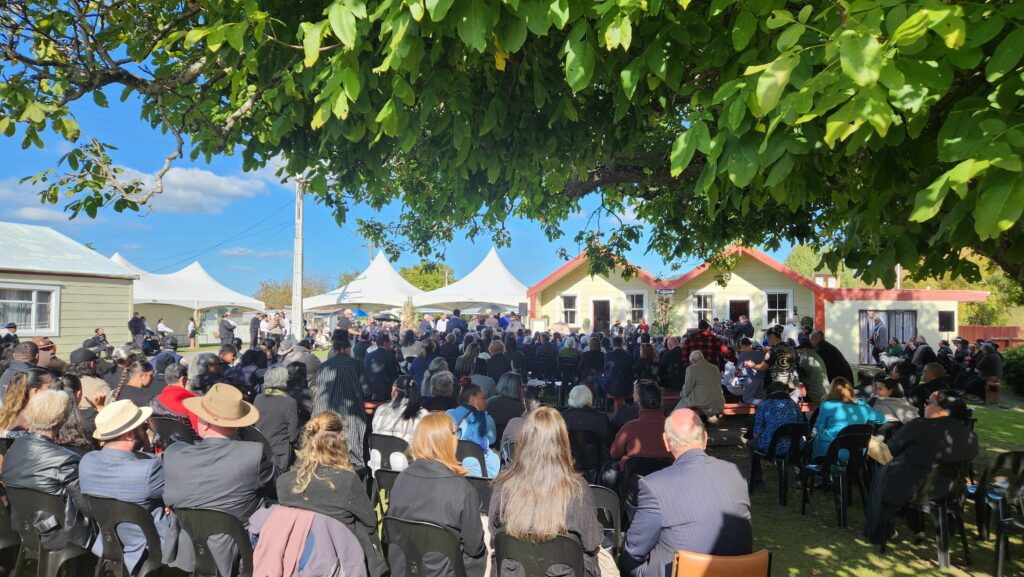
On behalf of Ngā Hapū o te Iwi o Whanganui, as we prepare to sit together on the Takapau Whāriki, let me be clear from the outset. This is not a pathway where we come seeking justice.
We have never expected justice from these processes. But we do expect sincerity. To be tika and pono.
We expect that when you come to Te Whare Kaho o Whanganui, our tribal domain, and reach the gateway Te Tomokanga ki te Matapihi, that you do not arrive as the Crown of old but that you stand as a pillar of Te Rino, tangata tiriti, alongside the pillar of Te Uku, tangata whenua, built upon ngā mātāpono, our values, and tikanga, embodied in the whakatauāki a Tinirau: toitū te kupu, toitū te mana, toitū te whenua.
If those words are to mean anything, they must live in action, not apology. Minister, before we ever met Europeans, we met the consequences of them.
In 1819, we encountered muskets and pātītī on the awa, long before we encountered the people themselves. We faced them. We adapted.
We held our ground. By the time the first Europeans arrived here in 1831, seeking trade and preserved heads and after punishing Joe Rowe and his mates, we took Andrew Powers hinterland, to better understand something of the world that was coming. And by 1839, before te tiriti had even been brought to Whanganui, the New Zealand Company was already seeking to acquire vast areas of our whenua.
Three rangatira were taken aboard the Tory near Waikanae and presented with an English language deed, said to convey more than a million acres from Manawatū and Patea inland to Tongariro.
It was ambiguous, inadequately changed later, and later challenged by other Whanganui Rangatira, who said those three had no right to sell without the consent of the other chiefs. So when we signed te tiriti in May 1840, we did so not as naive people but as rangatira. We signed through our own lens. Through kawa and tikanga, through whakapapa, through relationship.
It was not until 23 May 1840 that Henry Williams brought the Cook Strait sheet to Whanganui. No Whanganui rangatira signed the English version.
We signed the te reo Māori text. The text that guaranteed to us te tino rangatiratanga o rātou whenua, o rātou kāinga, me o rātau taonga katoa. And I will honour those who signed:
Te Anaua, Tawhito, also known as Kāwana Pitiroi Paipai, Te Māwae, Rereōmaki, Te Tauri, Rore, Te Pēhi Tūroa, Taka, Kurawhātia, Te Rangiwhakarurua, Uripō, Te Hiko o te Rangi, Takarangi and Te Pēhi Pākoro Tūroa.
These were not signatures of surrender. They were commitments to relationship. Even then, the setting was confused by the Crown and the New Zealand company arriving almost on top of each other. One seeking signatures to te tiriti, the other seeking signatures to land. Pēhi Tūroa later said: “A blanket is no payment for my name. I am still ariki.” That is the point we must remember. Our tūpuna did not give away their mana.
They expected relationship, reciprosity and the protection of rangatiratanga. But minister, what followed was not sincerity. It was inconsistency. It was contradiction. It was breach after breach after breach.
The company came ashore with goods. Some of our rangatira, including Te Anaua and Te Pēhi Tūroa received little or nothing.
Many of our people understood those goods through tikanga as part of a gift exchange, not as payment for the permanent loss of land.
The very next day, Whanganui Māori returned a huge quantity of provisions. A gift for a gift. That was our law operating – our kawa, our tikanga. But the Crown and the company read the same moment through another law, another empire, another hunger.
By 1841 settlers were already arriving. They established Petre. They surveyed, they encroached.
Our people protested in the strongest terms, saying you may take our land. But you shall break our necks first. This is the place of my ancestors.
Here, we have fought our battles. And here lie our dead. What payment will buy it? We will not sell it.
These words carry the same message we carry today: Toitū te whenua.
In 1844 when Commissioner Spain pressed our people, Te Māwae said: “When my throat is cut, you will get the land. I still say so. I want not your money, and I will not take it.”
And still, Spain responded that the land would be awarded whether our people took the payment or not. That was not partnership. That was not consent. That was the early shape of Crown insincerity.
Then, Governor Fitzroy told our people that no land would be taken against their consent. But soon after, Governor Grey and his officials returned to complete the company’s transaction.
The Crown began negotiating not only for the 48,000 acres Spain had referred to, but for a much larger rectangular block of 89,600 acres. The historical account records that Whanganui Māori knew little or nothing about the boundaries and that Crown officials did not explain the discrepancy.
Again, minister, the pattern is clear. Words one day, something else the next. And still our people tried.
‘Our people were trying to hold a relationship together. They were trying to preserve peace. They were trying to make space for two peoples to live.’
Te Māwae spoke of succeeding generations. Our people negotiated for reserves at Pūtiki, Waipākura, Kaiwhaiki, Roto Pauri, Aramoho and Tutaeika, but the Crown refused the full extent of pā, urupā and cultivations sought by Whanganui Māori and abandoned the promise of tenths as investment reserves.
Even a Crown official observed that vast tracts of cultivated land were being parted with. And that it could not be without regret on our part.
Our people were not simply selling land. They were trying to hold a relationship together. They were trying to preserve peace. They were trying to make space for two peoples to live. Mā te piharau anō te piharau, ka tika. Local solutions for local problems.
And then in June 1846, when our people had relied on the Crown’s word that payment would be made, the Crown’s negotiator abruptly left.
Tūroa said to McLean that the European should be ashamed of running off so suddenly when our people had relied on their words as truth. He said: “No, I now see the words of Europeans are not so.” That is the line, Minister. That is the wound. The words were not so.
We met again at this junction after the battles of Pā Tupuhau and Pukenamu. We thought we had made peace.
But the Crown had declared marshal law. Whanganui men were court-marshalled. Hōhepa Te Umuroa and others were sent away, transported to Van Diemen’s Land, despite not being accused, tried or convicted of murder. Hōhepa died there, aged only 25, far from his awa and far from his people.
In April 1847, Hapurona Ngārangi, a Pūtiki rangatira, was shot in the face by a junior Crown military officer. Two days later, six Māori youths attacked an isolated pākehā family. Five were captured by Pūtiki Māori. They had no lawyer. They pleaded guilty under martial law. Four were hanged in front of the stockade at Pukenamu, which remains tapu to this day because of those deaths.
The Crown imposed martial law but Whanganui Māori still acted under kawa and tikanga: toitū te mana. The historical account says plainly that while the Crown imposed martial law, Māori in Whanganui acted under our own legal jurisprudence. Those who joined the tauā did so under kawa and tikanga.
And that is the deeper point. Even in war, we carried lore. Even in conflict, we carried kawa. Even in grief, we carried tikanga.
‘When we speak of insincerity, we do not speak in abstract terms. We speak of houses burnt. We speak of graves desecrated. We speak of tapu violated. We speak of words broken.’
And when fighting ended, our leaders again moved toward peace. But what did the Crown do? The Crown burned down one of the most elaborately carved wharepuni belonging to the Tūroa whānau.
And worse than that, the Crown desecrated the resting place of the whare ariki, a Te Pēhi Tūroa. That must be said plainly. That must be remembered.
The historical account records that the monument to Pēhi Tūroa was extremely tapu. It was a large, beautifully carved waka, painted with red ochre and set upright at Waipākura, marking the place where Pēhi died in 1845.
Captain White and his Crown military officers tried to pull it down. Then, while burning fern to assist future military movements, their fire burnt houses – the elaborately carved wharepuni of the Tūroa whānau – and, in what the account calls an act of sacrilege, the monument itself.
So when we speak of insincerity, we do not speak in abstract terms. We speak of houses burnt. We speak of graves desecrated. We speak of tapu violated. We speak of words broken.
And still, despite this, our people tried. We tried to build relationship. We tried to meet the Crown halfway. Kāwana Paipai took the name Pitiroi Tawhito i te Rangi after Governor Fitzroy. Major Kemp named his daughter Wikitoria after Queen Victoria. Many of our tūpuna took the name Hōri Kīngi after King George.
These were not acts of submission. They were acts of good faith. But time and time again, their faith was not returned.
The Crown created proxy wars amongst our own people. At Moutoa, Pēhi Pākoro tried to prevent war at Whanganui. He tried to dissuade Mātene Rangitauira from coming down river. He placed a tapu over the lower river, and when that failed, Whanganui Māori fought Whanganui Māori at Moutoa Island.
The battle lasted only 15 minutes but it left deep scars, with Mātene and around 50 of his followers killed, along with 14 of the opposing force.
Afterwards, the prisoners and their captors were closely related. Te Anaua and Pēhi Pākoro asked the Crown to release them. The Crown refused. Te Anaua asked whether they had not done enough yet for the Queen and our friends pākehā. Still, the Crown refused.
Then the Crown erected a monument at Pākaitore.
It honoured those who fought on one side and condemned their kin as fanatics and barbarians. But where are the markers that honour those who stood for tino rangatiratanga?
[The names are being confirmed and will be added here.]
These are not footnotes. These are our people.
When the wounded, the widows and the defeated sought refuge under Te Pēhi Pākoro at Ōhinemutu, that moment should have been one of restoration. Instead, it was politicised.
It was used to justify further conflict at Ōhoutahi and Pīpīriki.
‘Whanganui authority did not come from appointment by a centralised state. It came through whakapapa, hapū kinship, rangatira status, kawa and tikanga.’
And still, even then, our people acted in good faith. When Tāwhiao sent word to Tōpia Tūroa at a time when the Kīngitanga and those aligned with the Crown stood together to pursue Te Kooti, our people went. They fought along side the Crown, all the way to Ōhiwa.
And what happened when they returned? Major Kemp was presented with the Queen’s sword of honour in June 1870 and was awarded the New Zealand Cross in 1874, one of the highest honours of the Crown. In 1880, he organised a Māori land trust to administer a large tract of inland Whanganui whenua, declaring it off limits to all European settlers and marked by four pou whakairo, the last of which is upstream at Kauarapaoa. And despite all he did for the Crown, he was undermined, challenged, revoked. His efforts to protect our lands were dismissed.
Minister, this is not one story. This is a pattern and it is a pattern of insincerity. The Crown came here with systems refined across the Victorian empire. It came through missionaries, soldiers, surveyors, governors, magistrates and administrators. It came with a belief in Crown sovereignty, hierarchy, command and military force.
Whanganui authority did not come from appointment by a centralised state. It came through whakapapa, hapū kinship, rangatira status, kawa and tikanga.
These were meetings between two legal orders, not between a sovereign and subjects. And yet the Crown failed again and again in the one thing that mattered most: keeping its word. Toitū te kupu.
That is why we are here today. Because that pattern cannot continue. It cannot continue if we are to thrive as a nation. It cannot continue if Te Tiriti is to mean anything at all. Today we see it still. Land is returned, but it’s encumbered. Responsibilities are handed back, but without the resources to uphold them. Treasury funds for treaty implementation in the department are currently frozen. Expectations remain.
That is not partnership. That is not sincerity. So, Minister, this is the challenge. Not to apologise. Not too acknowledge. But to change. To place He Rau Tukutuku on the Takapau Whāriki and sit with us truly. To uphold your side of Te Tomokanga ki Te Matapihi.
Tā Te Rino i tukituki ai, mā Te Rino anō e hanga. What the Crown has destroyed, the Crown must restore. To honour the values that the gateway is built on, toitū te kupu, toitū te mana, toitū te whenua.
It is what we ask of you today. Not justice, but sincerity. Nō reira, tēnā koutou, tēnā koutou, tēnā koutou katoa.