
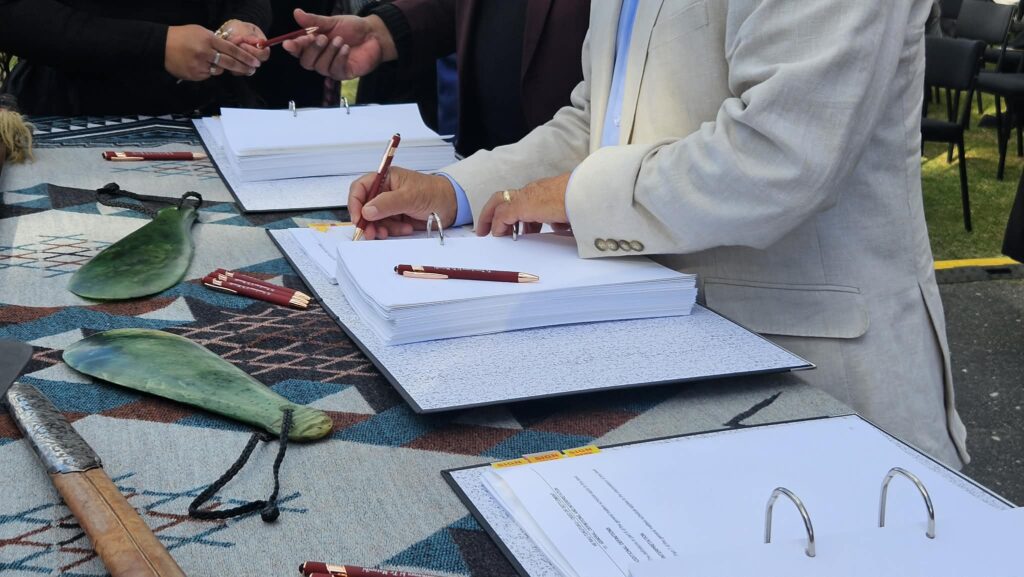
Today is not just a formal occasion. Today is a day of remembrance of dignity and of deep responsibility. We gather here, carrying the names, the hopes and the weight of history on our shoulders, not by choice, but by inheritance.
For generations, Ngā Hapū o te Iwi o Whanganui have stood firm. Our tūpuna never let go of the truth, they never let go of our whakapapa, our whenua, our mana and our rights under Te Tiriti o Waitangi.
And through the battles and occupations, of courts, hearings at the Waitangi Tribunal, through negotiations of a settlement process that has stretched across decades, we have carried those truths forward. We have lived through the consequences of promises broken, land lost, the theft of our lands, our authority – our tino rangatiratanga – undermined, disrupted, our voices silenced.
That mamae is not abstract, it has been real, it’s been lived in our kāinga, in our pā and across generations. And yet, despite everything we’re still here, we’re still standing. We are still speaking and we are still united.
Throughout this long journey, we have asked one thing of the Crown – to face the truth, not to soften it, not to delay it, not to redefine it, but to face it.
This journey has not been easy. It has been long, it has been exhausting and at times it has been deeply painful. As Tahu Kakahi reminded us, tā te rino i tukituki ai, mā te rino anō e hanga: what the Crown has broken, the Crown must repair.
So let us be very clear. This Deed of Settlement is not an act of generosity from the Crown. It is a fulfilment in part of an obligation long overdue, and even then it is only a step. Because no settlement can fully account for what was taken. It has not restored or returned every acre of whenua stolen from us. It cannot return the generations who lived and died without justice. It cannot remove totally the mamae that still lives within our whānau, our hapū today.
So we do not stand here in celebration of perfection. We stand here in acknowledgement of progress, of a continuing journey, hard-fought, long argued, and never guaranteed. But today matters, it is a day of recognition, a day of accountability, a day when the truth of our history stands in full view, and it is a day where our hapū, our iwi takes another step forward with strength, with pride, with purpose. Let us enjoy the moment. Let us enjoy the day and celebrate this together.
We honour those who brought us here. Those who challenged injustice when it was easier to remain silent. Those who held the line for our hapū, for our iwi. Those who carried this kaupapa, often for many years, and often at great personal cost. Some are no longer with us, but their presence is still here. We stand because they stood, we speak because they spoke, we are here because they never gave up.
We have long known the saying e kore te uku e piri ki te rino, clay and steel do not bind, and yet what has changed is this: we have refused to meet the Crown on their terms alone. We have brought forward our own framework Te Tomokanga Ki Te Matapihi, a relationship grounded in our values, our tikanga, our world view, a relationship that binds to uku and te rino, not through force but through commitment, a relationship that now must give life to ngā mātāpono, toitū te kupu, toitū te mana, toitū te whenua.
And Minister, we will hold you to your words that you wrote to us in regard to acting in good faith and giving life. Mark my words, mark our words….
That is the true shift of the core of this settlement, not just what is written in the deed, but how we move forward from it. Yes, there are some tangible outcomes. Yes, a small amount of our whenua has been returned. However, also an opportunity has been given to ensure that more land is returned.
Resources have been secured, pathways opened and recognition embedded. These matter. Our tūpuna fought for these. But if that is all we see, then we have missed the point, because He Rau Tukutuku is not just a record of settlement, it is a responsibility.
From this day forward the question is no longer what will the Crown do? The question becomes: what will we do?
We now enter the post-settlement phase, and this is not an easier part. In fact, it’s going to be a lot harder. Because negotiation requires resistance, and transformation requires discipline. Structures like Takapau Whāriki Trust, the PSGE, the post settlement governance entity, will carry responsibility, but they are not the settlement. We are. Our hapū, our marae and our uri.
And mark our words, we will uphold that forever and a day. And I’ll repeat it. Our hapū, our marae and our uri. Because settlements do not change outcomes on their own. People do. We now hold some tools our tūpuna did not have – whenua returned to our care, resources to invest in our people, opportunities to restore our reo, our identity, our future.
As our tūpuna remind us, mā te piharau anō, te piharau e whakatika: our solutions must come from us. The healing of Whanganui must be led by our hapū of Whanganui.
As we stand here today, one message – and this message should be stated quite clearly. The Crown, both present and future, must not weaken or diminish the place of Te Tiriti o Waitangi in law or practice. Te Tiriti is not a convenience, it is not a clause or clauses to be written, it is not a historical footnote. It is a founding covenant promise of this nation.
To honour Te Tiriti is not to divide, it is to strengthen. We do not stand here asking for favours. We stand here expecting that solemn promises must be honoured.
And in the context of the present situation that we’re in, we as Ngā Hapū o te Iwi o Whanganui make it very clear, Minister, that these words that I’ve just stated, we will stand up for – and we expect you to do the same, and we would strongly encourage you and your colleagues to review your present situation.
I’ll leave it at that.
Our people once extended He Whiri Taunoka to the crowd at Ōhinemutu, a gesture not of weakness but of courage – a line drawn in the earth that said the conflict rests here. Their honouring begins with us. Today, we respond and we offer He Rau Tukutuku, a reflection of that original gesture, a symbol of Te Tomokanga Ki Te Matapihi, a commitment to a values-based relationship going forward: ko te rau tukutuku. He rau mahara, a symbol of remembrance. He rau aroha, a symbol of compassion. He rau moemoea, a symbol of hope. He ara tuku rau, an offering of abundance for the future we are building together.
To our tūpuna, we remember you. To our people, we honour you. To our mokopuna, we commit ourselves to you. He ao apōpō, he ao tea – our legacy, our aspirations, our future.